TL;DR — Early gains are common when student support systems launch. Sustained improvement requires structure across Tier 1, Tier 2, and Tier 3. Most stalls occur when Tier 2 systems lack clarity, Tier 3 supports become reactive, and implementation fidelity is assumed rather than verified.
When districts launch new student support systems, early results are often encouraging. Staff engagement increases. Students respond positively. Data shows short-term improvement. Then progress slows — and leaders begin asking whether they need something new. In most cases, the stall is not a failure of the idea. It is a failure of system design and follow-through.
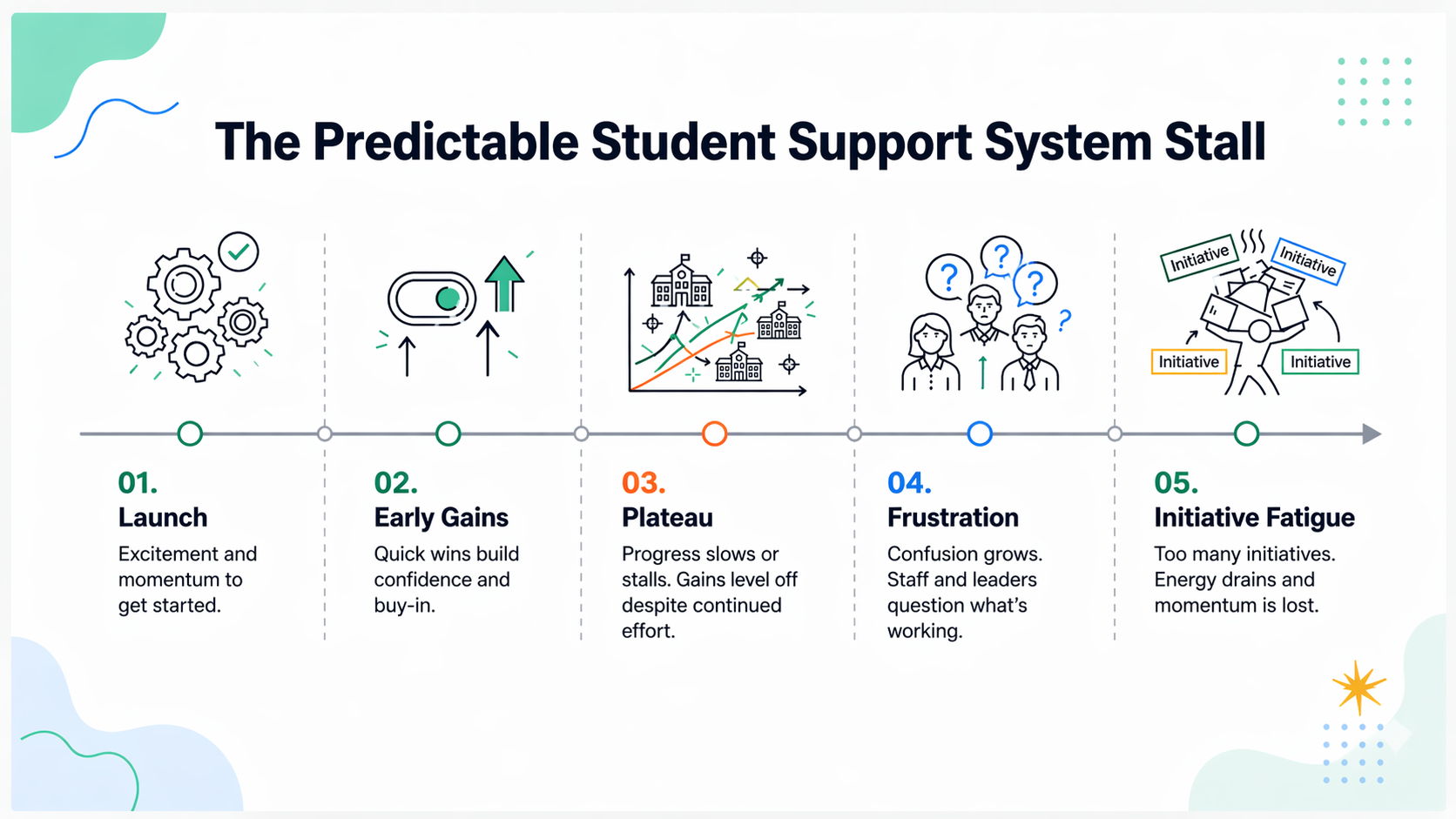
The predictable stall pattern
Across districts, the pattern looks remarkably similar. Training is completed and staff are energized. Tier 1 improvements and early Tier 2 wins appear. Progress slows and variation increases. Staff feel stretched and leaders feel pressure. Attention shifts to what is next. This cycle is predictable — and preventable.
Where systems typically break down
Stalls most often emerge at the intersection of Tier 2 and Tier 3, where complexity increases and clarity matters most. When Tier 2 systems are underdeveloped, Tier 3 demand rises, supports are mismatched to need, and staff capacity erodes. Tier 3 then absorbs complexity that Tier 2 was never designed to manage alone.
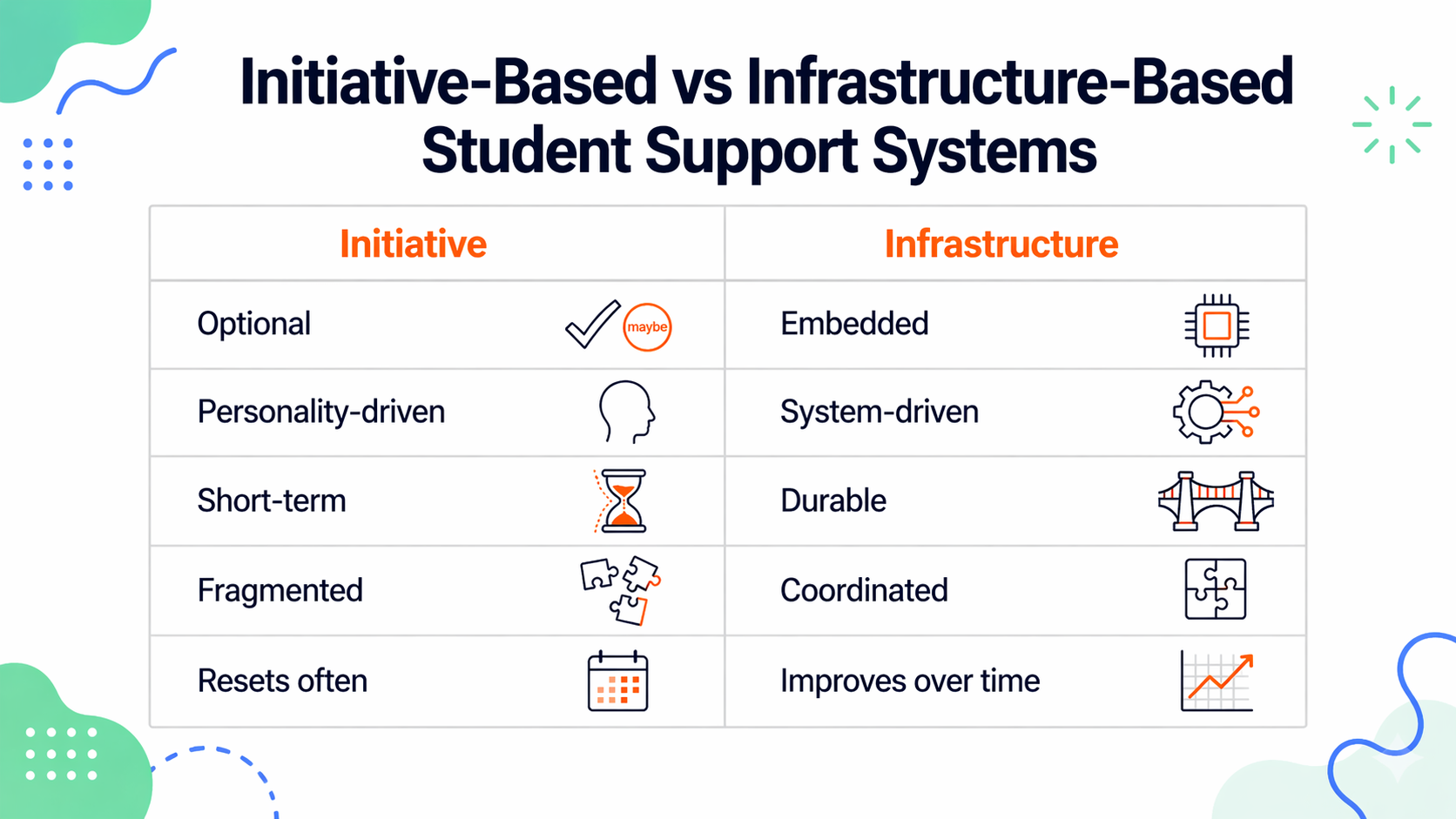
Five system gaps that cause student support systems to stall
1. Tier 2 fidelity is inconsistent — and Tier 3 pays the price
Many districts assume Tier 2 supports are being implemented as intended. Often they are not. Variation in dosage, frequency, group size, and monitoring routines means Tier 2 outcomes vary widely — even within the same district. Tier 3 challenges are often Tier 2 fidelity problems in disguise.
2. Tier 2 and Tier 3 are blurred instead of differentiated
Without clear differentiation, Tier 2 stretches upward and Tier 3 stretches downward, and neither functions well. Effective systems clearly define what makes Tier 2 targeted, what makes Tier 3 intensive, and when movement between tiers occurs. Clarity reduces escalation and protects staff capacity.
3. Progress monitoring stops after entry
Many systems monitor data to place students, but not to guide adjustments. This is especially damaging at Tier 2, where timely adjustments prevent escalation. Tier 2 is the checkpoint — Tier 3 is the exception, not the solution to uncertainty.
4. Ownership and coordination break down at Tier 3
Tier 3 supports require the highest level of coordination. In stalled systems, roles are unclear, services operate in parallel, and communication is inconsistent — leading to fragmented support, duplicated effort, and staff burnout. Tier 3 succeeds when the system carries the weight, not individuals.
5. Systems depend on champions instead of structure
Early gains often coincide with strong leadership or passionate staff. When those individuals leave, routines fade, decision rules weaken, and consistency erodes. Sustainable systems document routines, clarify roles, and embed expectations. Durability is designed, not inherited.
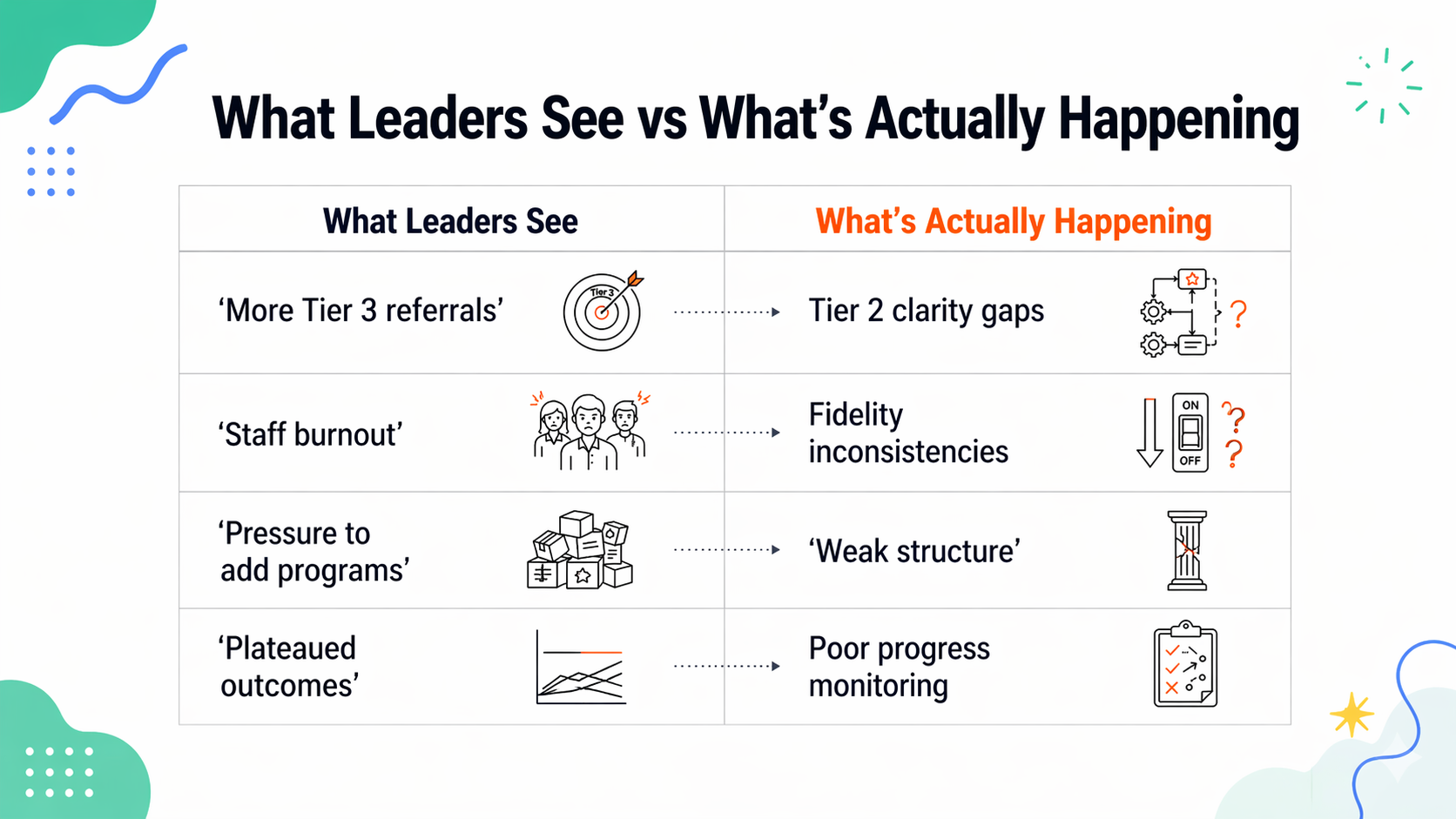
What leaders see vs. what is actually happening
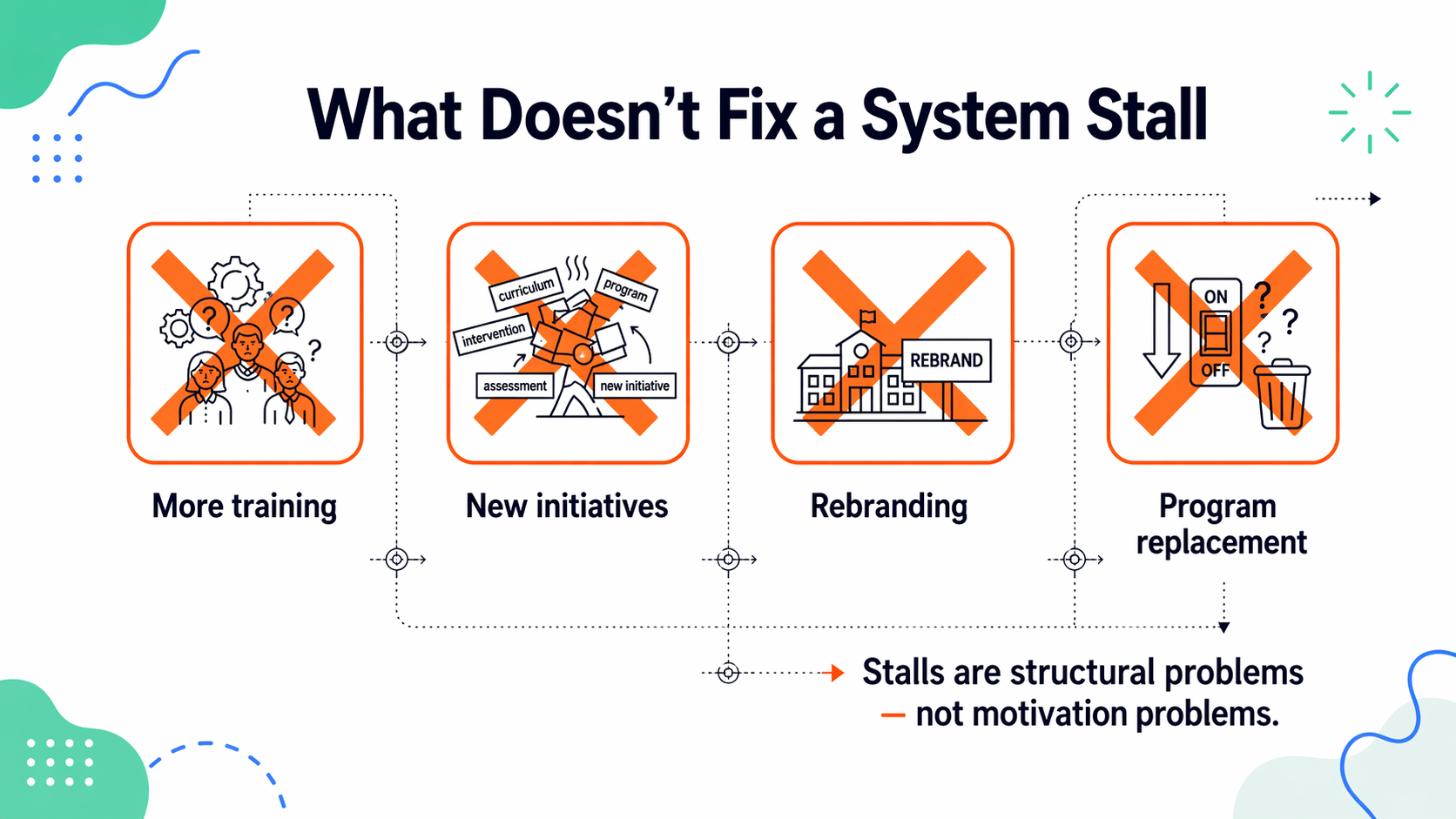
Leaders often see more Tier 3 referrals, staff frustration, inconsistent outcomes, and pressure to add programs. What is actually happening is that Tier 2 systems lack clarity, fidelity is uneven, progress monitoring is insufficient, and Tier 3 is compensating for system gaps. Without a system lens, leaders treat symptoms — not causes.
What changes when Tier 2 is strengthened
When districts invest in clear, consistent Tier 2 systems, students receive targeted support earlier, progress monitoring improves, escalation to Tier 3 becomes more precise, staff confidence increases, and Tier 3 becomes manageable rather than overwhelming. Tier 2 is the leverage point where systems either stabilize or strain.
Final takeaway
The critical question is not why this stopped working. It is: "Where does our system need more structure — especially at Tier 2 — to support Tier 3 more effectively?" Districts that answer that question honestly do not need to chase new initiatives. They strengthen the system they already have.
Key takeaways:
• Most stalls are caused by system gaps, not lack of effort.
• Tier 2 clarity prevents Tier 3 overload.
• Fidelity and progress monitoring are essential for sustainability.
• Tier 3 reflects system health, not system failure.
• Infrastructure — not heroics — sustains impact.
Ready to strengthen Tier 2 and reduce Tier 3 overload? Request a quote →
Read next:
→ Read next: Evaluating MTSS systems
→ Read next: Tier 1 vs Tier 1–3