TL;DR — Before renewing or replacing a student support system, evaluate whether it helps leaders explain variation across schools, supports consistent decision-making across Tier 1–3, and sustains outcomes through staff and leadership changes. Renewal decisions should be based on system performance — not familiarity, momentum, or anecdotal success.
Renewal conversations often begin with a simple question: Is this working? But for superintendents and district leaders, that question is incomplete. The more important question is whether this student support system is helping you understand why outcomes look the way they do — and improve them over time across all tiers of support. Renewing or replacing a student support system is not just a purchasing decision. It is a systems decision that shapes consistency, equity, staff workload, and sustainability across schools.
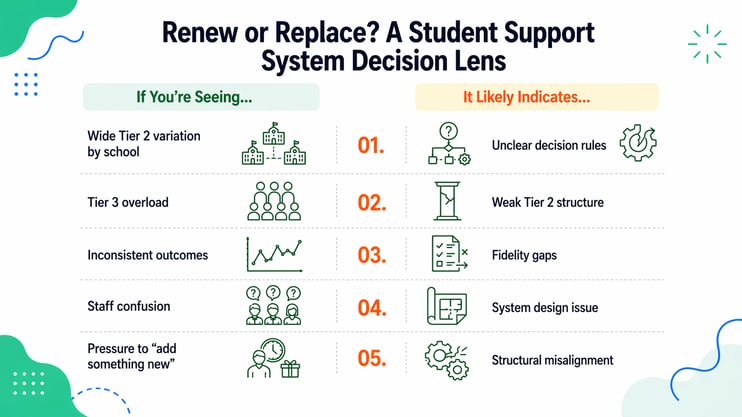
Question 1: Can we explain why outcomes differ across schools — including at Tier 2 and Tier 3?
Variation across schools is inevitable. Unexplained variation is not. District leaders should be able to explain why Tier 2 and Tier 3 identification rates differ across schools, whether that variation reflects student need or system inconsistency, how supports are coordinated across teams and services, and whether differences are driven by implementation, access, or decision rules. Strong systems provide shared data structures, a common language for diagnosing variation, and clarity that supports improvement without blame.
Question 2: Do teams have clear decision rules — or are they guessing?
Student support systems break down when decisions rely on intuition instead of clarity. District leaders should be able to answer when a student enters Tier 2 versus Tier 3, what data triggers that decision, how long a support continues, and when a support is adjusted, intensified, or faded. If these answers vary by school, the system increases inequity and cognitive load for staff. Clarity replaces urgency with confidence — and gives more equitable access to supports.
Question 3: Are Tier 2 and Tier 3 supports addressing root cause — or just reacting?
Tier 3 overload is often a downstream effect of earlier system gaps. When Tier 2 supports are misaligned or diagnostic clarity is weak, Tier 3 becomes reactive — absorbing complexity instead of addressing need. In most districts, Tier 2 is the leverage point: when Tier 2 supports are clear, consistent, and well-monitored, Tier 3 becomes more targeted, more coordinated, and less overwhelming.
Question 4: How is implementation fidelity monitored, especially for Tier 3?
Before replacing a student support system, districts must confirm whether it was implemented as intended. This is especially critical for Tier 3, where intensity varies widely, coordination across services is complex, and fidelity is often assumed rather than verified. Replacing a system without verifying fidelity often resets progress rather than improving it.
Question 5: What happens when leadership or staff changes?
Sustainable student support systems do not depend on individual champions. When champions leave, Tier 3 supports are often the first to collapse — decision rules fade, coordination weakens, and staff revert to reactive problem-solving. Strong systems embed clear roles and responsibilities, shared routines, and documentation that survives transitions. Durability is a design feature, not a byproduct.
Question 6: Is the system reducing complexity or adding to it?
Implementation fidelity is one of the most overlooked — and most critical — components of student support systems, particularly at Tier 3. Programs and supports rarely fail in theory. They fail in execution. Strong systems help districts confirm that support was delivered at the right dosage, with consistency, and at the expected quality. Without fidelity checks, teams often misattribute implementation gaps to ineffective supports, leading to unnecessary changes and initiative churn.
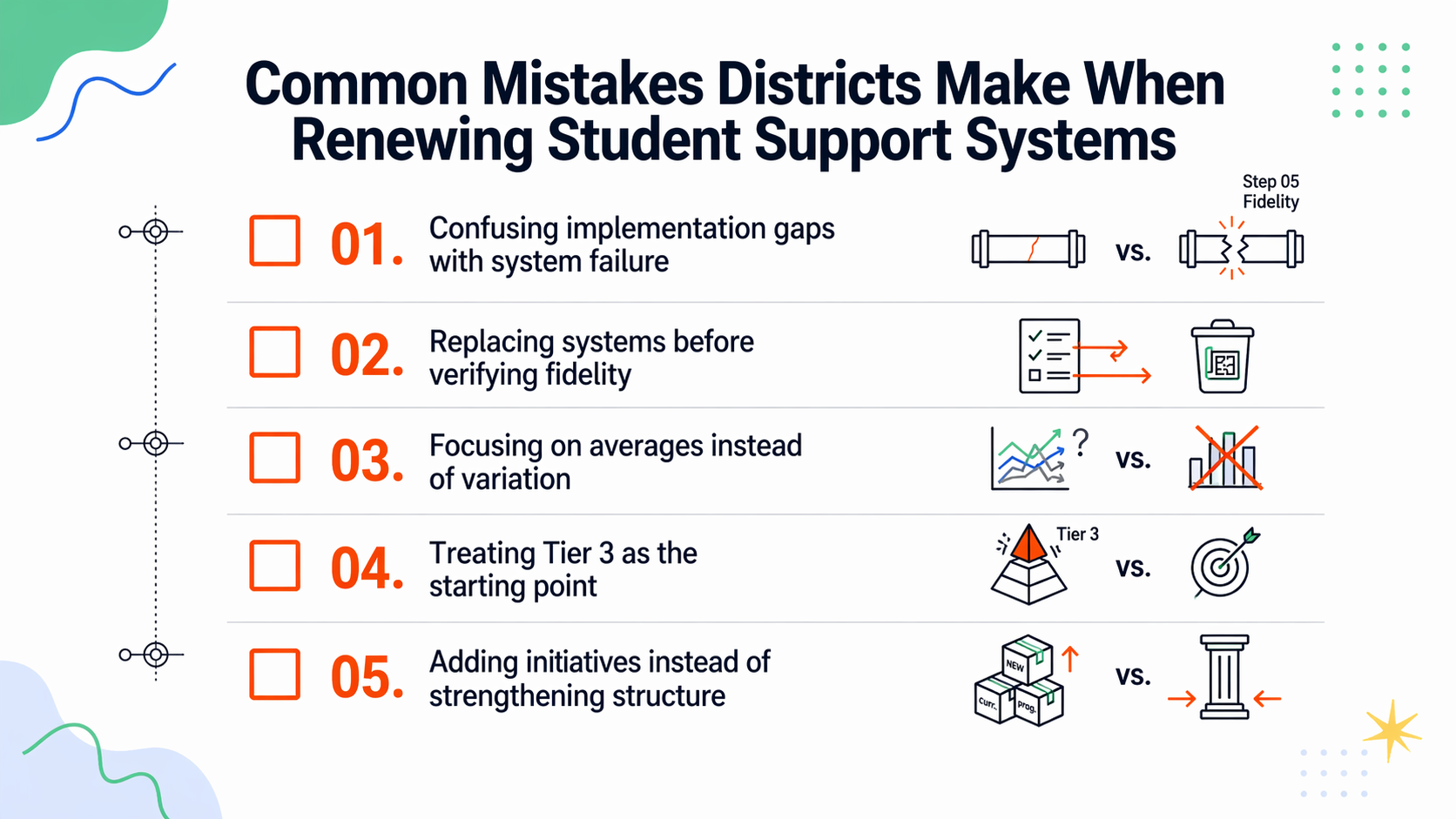
Common mistakes districts make when renewing student support systems
Before concluding that a system needs replacing, districts often focus on averages instead of variation, confuse implementation gaps with system failure, replace systems without verifying fidelity, add new initiatives instead of strengthening structure, and overlook Tier 2 as the primary leverage point. These mistakes reset momentum rather than improving outcomes.
Final takeaway
"Does this student support system help us strengthen Tier 2 decision-making — and, as a result, make Tier 3 more precise and sustainable over time?" Systems that meet this standard do not require frequent replacement. They evolve.
Key takeaways:
• Renewal decisions should consider Tier 1–3 coherence, not isolated success.
• Tier 2 is the primary leverage point in most districts.
• Tier 3 variation often reveals upstream system gaps.
• Clear decision rules reduce inequity and burnout.
• Fidelity must be verified before replacing systems.
• Sustainable systems outlast individual champions.
Want to strengthen Tier 2 student supports in your district? Request a quote →
Read next:
→ Read next: Evaluating MTSS systems
→ Read next: Tier 1 vs Tier 1–3
.jpg)
.png)