TL;DR — Tier 1 student supports are essential — but insufficient as complexity increases. Districts that invest in Tier 1–3 MTSS-aligned student support systems experience greater consistency, clearer Tier 2 decision-making, and more sustainable outcomes.
Many districts begin with strong Tier 1 student supports — and that is appropriate. Universal supports create shared expectations, improve climate, and establish a common foundation. The divergence between districts does not happen at launch. It happens over time.
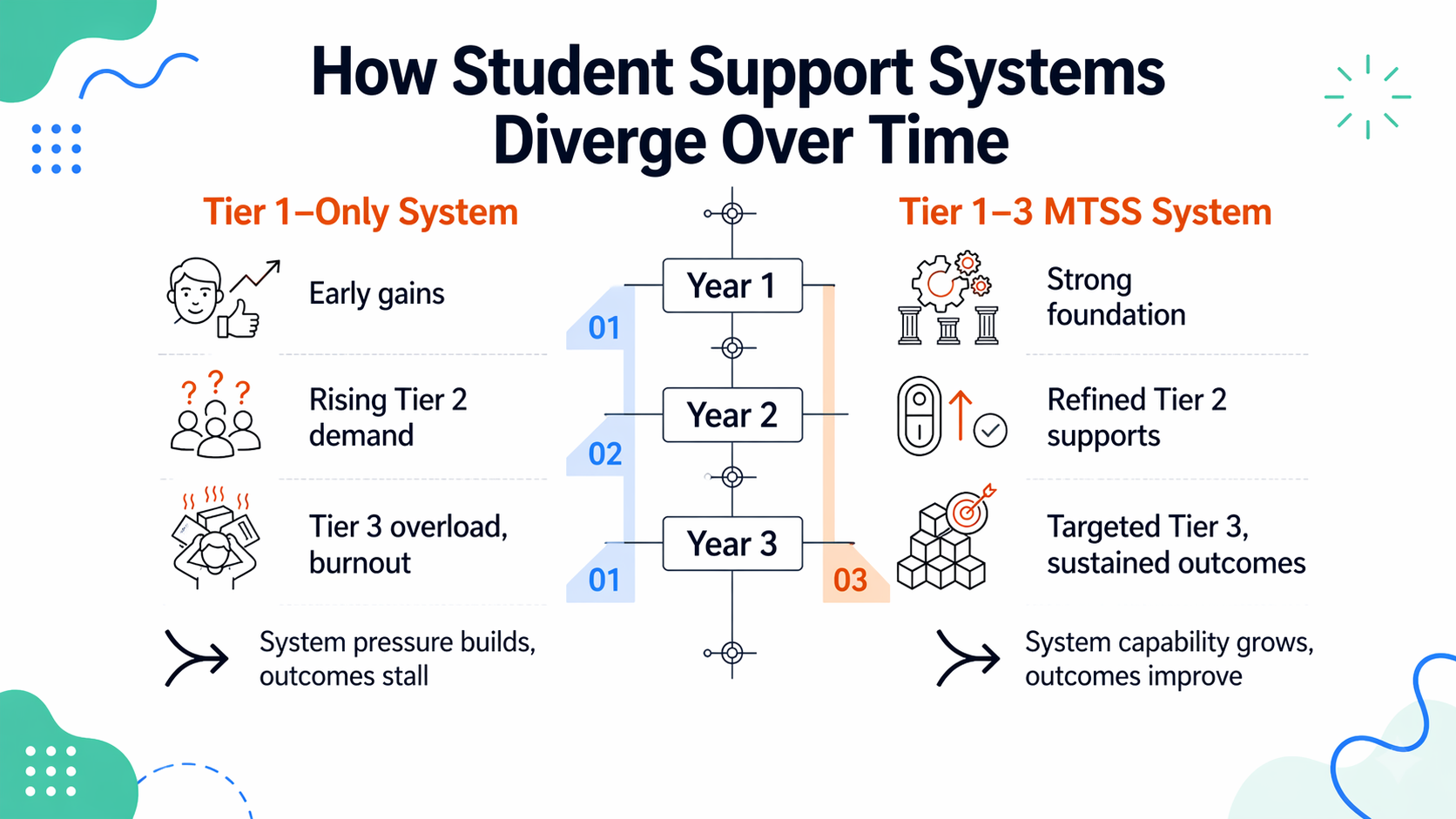
What districts experience with Tier 1-only systems
In the early stages, Tier 1-only systems often produce improved climate and engagement, positive staff feedback, initial reductions in referrals, and a shared sense of direction. Over time, however, Tier 2 demand steadily increases, Tier 3 referrals rise without clear criteria, variation grows between schools, and teams rely more on intuition than shared process. The system becomes reactive — not because staff lack commitment, but because the structure has not evolved.
Why Tier 1 alone becomes insufficient over time
Tier 1 systems are designed for prevention, not differentiation. As student needs diversify, universal supports no longer meet all needs, decisions become individualized instead of systematic, and equity becomes harder to monitor. Without a clear Tier 2 structure, districts often experience over-identification for Tier 3, inconsistent intervention intensity, and staff frustration and burnout.
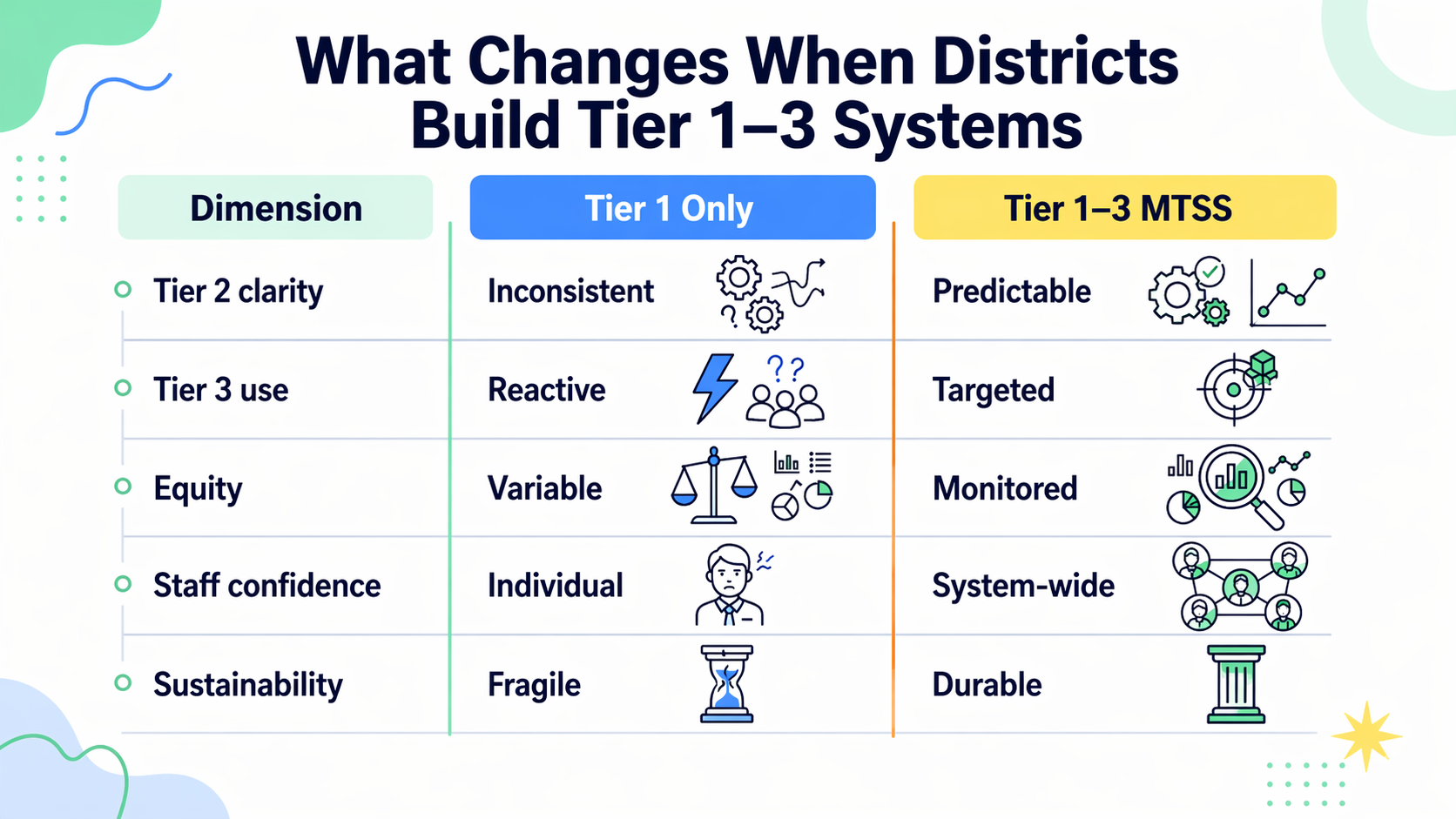
What districts experience with Tier 1–3 MTSS-aligned systems
Districts that intentionally build Tier 1–3 student support systems gain clear differentiation between Tier 2 and Tier 3, shared decision rules across schools, predictable pathways into and out of supports, stronger coordination across teams and services, and increased staff confidence in decision-making. Instead of asking what to try next, teams ask what the system tells them to adjust.
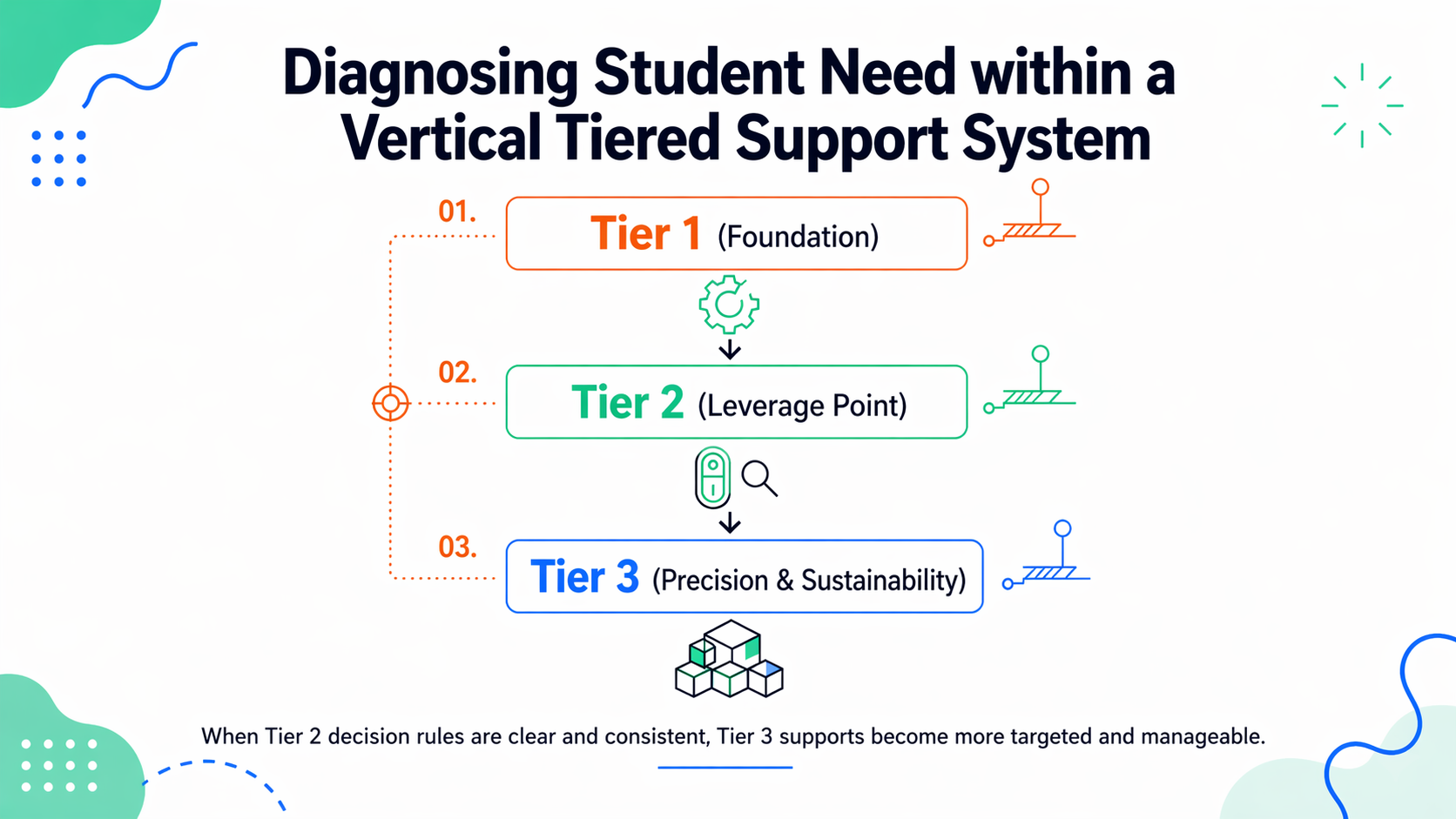
The role of Tier 2 as the hinge point
In most districts, Tier 2 is where systems either stabilize or strain. When Tier 2 is unclear, Tier 3 demand increases, supports are mismatched to need, and staff capacity is stretched. When Tier 2 is strong, students receive targeted support earlier, progress is monitored consistently, and Tier 3 becomes more precise and coordinated. Tier 3 outcomes are largely determined by the quality of Tier 2 design.
Why Tier 3 cannot be an add-on
When Tier 3 is treated as separate from MTSS, decision rules blur, coordination weakens, equity erodes, and sustainability suffers. Tier 3 should not operate in parallel to Tier 2 — it should be informed by it. When Tier 3 is embedded, it becomes manageable rather than overwhelming.
How systems diverge over time
Year 1 looks similar for both — strong Tier 1 focus, high engagement, early positive indicators. By Year 2, increased Tier 2 demand and emerging variation begin to surface. By Year 3, Tier 1-only systems are dealing with Tier 3 overload, staff burnout, and initiative fatigue, while Tier 1–3 MTSS systems have refined Tier 2 supports, predictable Tier 3 pathways, and sustained outcomes. The difference is not effort — it is design.
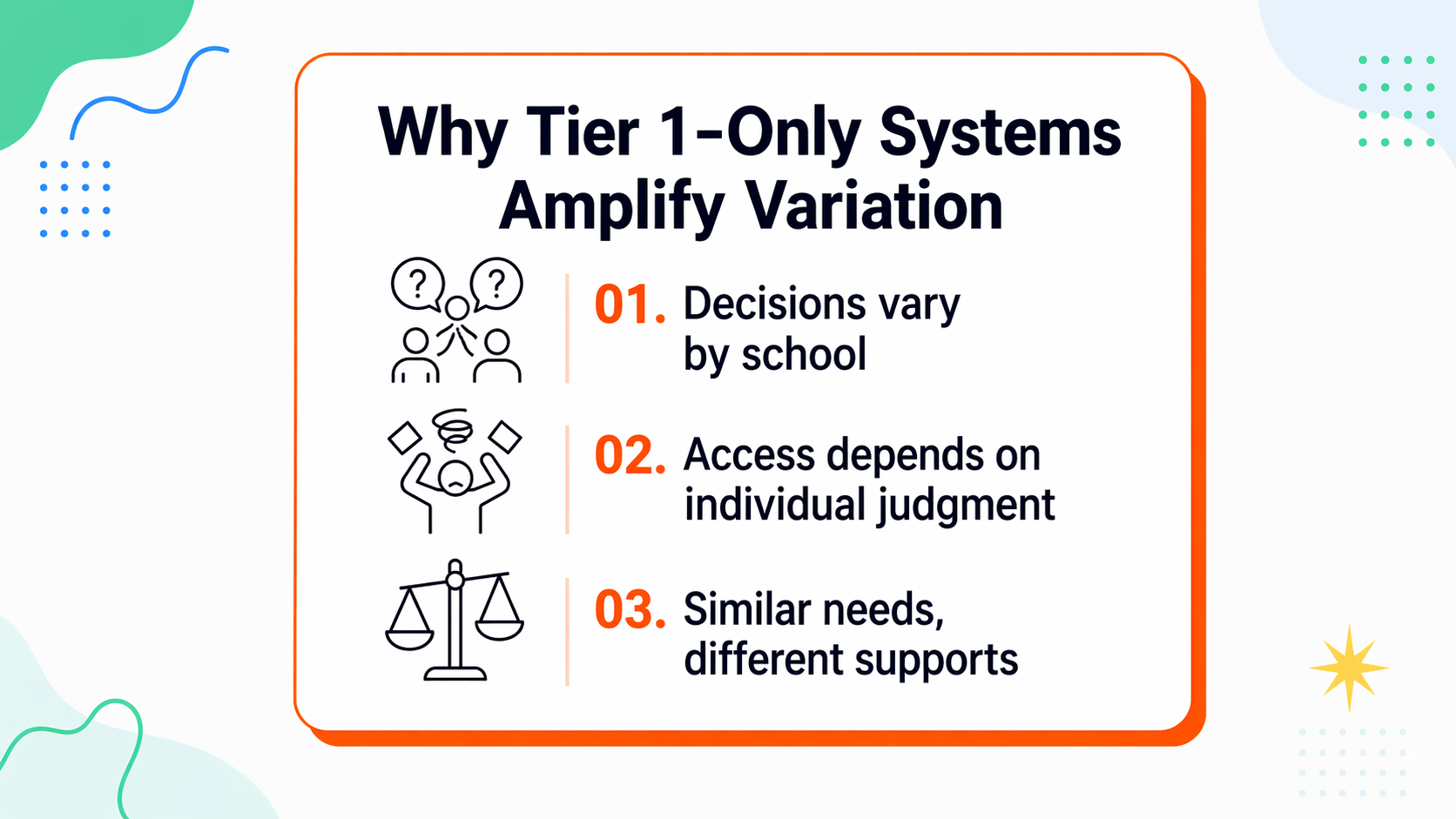
An equity lens
Without clear Tier 2 and Tier 3 structures, access to supports varies by school, decisions depend on individual staff judgment, and students with similar needs receive different supports. MTSS-aligned systems reduce this variation by using shared criteria, monitoring outcomes across schools, and adjusting supports based on evidence. Equity improves when systems — not personalities — drive decisions.
Final takeaway
Tier 1 is foundational. Tier 2 is the leverage point. Tier 3 reflects system health. Districts that invest in MTSS-aligned student support systems move from what should we try next to "What does our system tell us to adjust?" That shift is what enables consistency, equity, and sustainability over time.
Key takeaways:
• Tier 1 supports are necessary but insufficient alone.
• Tier 2 is the primary leverage point for system improvement.
• Tier 3 effectiveness depends on Tier 1 and Tier 2 clarity.
• MTSS-aligned systems reduce variation and burnout.
• Design — not effort — determines long-term success.
Want to see how MTSS student supports work in practice? View a sample →
Read next:
→ Read next: Why systems stall
→ Read next: 6 questions for District Leaders